
Commercial Solar Battery Storage Cost: 2026 Business ROI Guide

For many business owners, the battery conversation starts with one simple question: “What will it cost?” Fair question. But the better question is, “What is the battery supposed to do for the business?”
That’s because commercial solar battery storage cost depends heavily on the job you expect the system to perform. A retail center trying to reduce demand charges needs a different setup than a church protecting critical loads, a school seeking resilience, or a light industrial site with afternoon energy spikes.
Here’s the thing: batteries are not just backup boxes anymore. They’re operational tools. They can help businesses manage peak demand, improve uptime, make better use of solar production, and give dealers a stronger commercial energy solution to sell.
Commercial Solar Battery Storage Cost at a Glance
| Cost Factor | What It Affects | Why It Matters |
|---|---|---|
| Battery capacity | kWh storage size | Determines stored energy |
| Power rating | kW output | Determines how much load it can serve |
| Duration | Hours of discharge | Shapes backup and peak shaving value |
| Controls software | Dispatch strategy | Impacts savings performance |
| Site work | Installation complexity | Can move total project cost |
The National Renewable Energy Laboratory’s 2024 commercial and industrial battery model lists lithium-ion battery pack pricing assumptions from $215 per kWh for 2-hour systems to $199 per kWh for 4-hour systems, before full installed project factors are added. See the NREL 2024 Annual Technology Baseline for the underlying benchmark model.
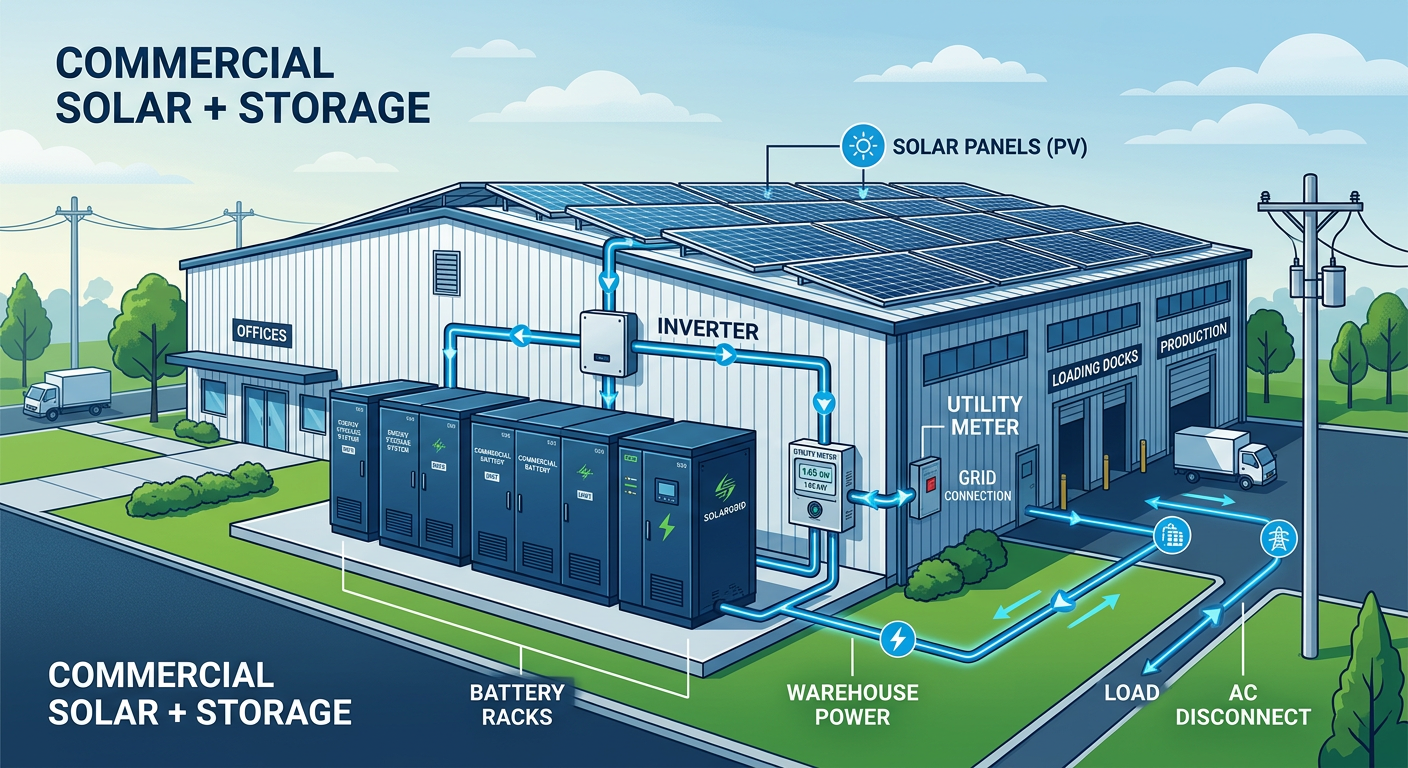
That doesn’t mean your installed project will equal pack price alone. A real commercial battery storage budget also includes inverters, balance of system, electrical upgrades, engineering, permitting, fire safety requirements, controls, commissioning, utility coordination, and long-term service planning.
What Actually Drives Battery Storage Pricing?
Battery Size and Discharge Duration
Commercial batteries are sized in two ways: power and energy. Power, measured in kW, tells you how much electricity the system can deliver at once. Energy, measured in kWh, tells you how long it can deliver that power.
A 250 kW battery with 1,000 kWh of usable storage is a 4-hour system. That may fit a site that needs peak shaving during costly afternoon windows. A smaller system may fit a facility that only needs to protect critical circuits during outages.
Demand Charges and Utility Rate Structure
For many commercial properties, demand charges are the hidden driver behind battery economics. The U.S. Department of Energy’s OSTI library notes that an NREL and Clean Energy Group analysis estimated nearly 5 million U.S. commercial customers could subscribe to tariffs with demand charges above $15 per kW, which can make storage especially relevant. Read the full program document at OSTI.gov.
If your client’s utility bill includes high demand charges, battery storage can discharge during peak usage windows and reduce the measured demand spike. That’s why restaurants, multifamily properties, offices, hospitality sites, schools, and light industrial buildings often deserve a closer look.
Backup Power Requirements
Backup design can change the budget quickly. A business that only wants to keep lighting, servers, security, refrigeration, or access controls running may need a smaller protected-load panel. A facility that expects broad backup across HVAC, elevators, production equipment, or whole-building loads needs more battery capacity and more complex design.
This is where commercial-grade planning matters. A battery that is undersized disappoints the customer. A battery that is oversized can damage the economics.
Solar Pairing and Existing Electrical Infrastructure
Solar plus storage can improve the value of both systems, but the site’s electrical infrastructure has to support it. Switchgear, service capacity, roof or ground-mount layout, interconnection rules, and utility approval all affect the final budget.
If a property already has solar, adding storage may still work, but the design team needs to assess inverter compatibility, metering, controls, and any utility program limitations.
How to Think About ROI Beyond the Sticker Price
A commercial battery is not evaluated like a simple appliance purchase. It’s closer to an energy asset with multiple value streams.
Potential value may include:
- Lower peak demand charges
- Time-of-use bill management
- Backup power for critical operations
- Better use of on-site solar energy
- Reduced outage risk
- Sustainability and brand value
- Potential incentive value
- Tenant or customer confidence
The U.S. Energy Information Administration explains that commercial and industrial customers can use on-site energy storage to reduce demand and associated demand charges, which are typically based on their highest observed electricity use during peak periods. See the EIA’s plain-language breakdown of energy storage uses and benefits.
For B2B dealers and sales reps, this matters because the sales conversation becomes more strategic. You’re not just quoting equipment. You’re helping a business control operating risk, protect reputation, and plan around volatile energy costs.
Incentives Can Change the Net Cost
For qualified commercial projects placed in service after December 31, 2024, the IRS says the Clean Electricity Investment Credit applies to qualified facilities and energy storage technology. The base amount is 6% of qualified investment, with the potential for higher value when requirements are met. Review current IRS guidance on the Clean Electricity Investment Credit.
Project teams should confirm details with a qualified tax professional, especially for prevailing wage and apprenticeship rules, domestic content considerations, ownership structure, nonprofit or tax-exempt treatment, and placed-in-service timing.
In other words, incentives can help, but they shouldn’t be treated like a casual add-on. They need to be planned early so the project is structured correctly.
Why Dealers Should Care About Battery Storage Cost
Battery storage creates a better commercial solar conversation because it connects directly to business pain points. Owners don’t just want lower bills. They want predictable operations, fewer surprises, and confidence that the installer won’t leave them exposed after the sale.
That’s why Independent Solar gives dealers, reps, and channel partners a stronger platform for commercial-grade solar, storage, service, and long-term support. If you want to align with a professional solar company that helps protect your reputation, you can become a solar dealer with Independent Solar.
Strong dealer partnerships matter even more when storage is involved. Batteries require careful load analysis, clean handoffs, clear communication, and reliable installation standards.
Cost Planning Checklist for Commercial Buyers
Before you compare proposals, make sure each quote answers the same questions.
Site and Utility Questions
- What are the last 12 months of utility bills showing?
- Are demand charges a major cost driver?
- Which utility tariff applies?
- Are there time-of-use windows?
- Does the business need backup power or peak shaving first?
Technical Questions
- What loads will the battery serve?
- How many hours of backup or discharge are required?
- Is the system AC-coupled or DC-coupled?
- What controls platform manages dispatch?
- What fire code and permitting rules apply?
Financial Questions
- What is the expected net project cost after incentives?
- What assumptions drive savings projections?
- Are maintenance and monitoring included?
- What warranty terms apply?
- How will performance be measured after commissioning?

Where Battery Storage Makes the Most Sense
Retail and Hospitality
Retail centers, restaurants, and hotels often face peak demand from HVAC, refrigeration, lighting, and guest comfort needs. Storage can help reduce costly spikes while supporting critical systems during interruptions.
Multifamily and HOAs
Battery storage can support shared loads, gates, lighting, pumps, security systems, leasing offices, and amenity areas. For property managers, resilience can be just as important as savings.
Churches, Schools, and Nonprofits
Mission-driven facilities often need predictable operating costs and community trust. Storage can help keep essential services running while supporting a visible sustainability commitment.
Light Industrial and Warehouses
These sites may have equipment-driven load spikes that create expensive demand charges. Battery storage can help smooth those peaks when the project is modeled correctly.
Trust, Reviews, and Long-Term Reliability
Commercial buyers and dealers should look beyond the lowest number on a proposal. A battery storage project touches electrical design, safety compliance, utility coordination, commissioning, monitoring, and ongoing support.
That’s why reputation matters. Before choosing a commercial solar installer or partnership platform, review real customer feedback and project satisfaction through the Independent Solar reviews page.
A clean installation experience protects the customer, but it also protects the dealer’s name. In B2B solar, trust is part of the product.
Build Commercial Growth With a Dealer-Friendly Solar Partner
If you sell solar, energy upgrades, roofing, real estate services, or commercial property solutions, battery storage can help you bring bigger value to better clients. Independent Solar supports dealer partners with commercial-grade installations, transparent communication, and a professional brand you can confidently represent.
Ready to grow with a team built for long-term opportunity? Apply to become a solar dealer and start building a stronger commercial solar pipeline.
FAQ
How much does commercial solar battery storage cost?
The total cost depends on battery size, power rating, duration, site conditions, permitting, controls, electrical upgrades, and whether the system is paired with solar. Pack-level benchmarks are useful, but the installed project budget is the number that matters for business planning.
Is battery storage worth it for every business?
No. It usually makes the most sense for businesses with high demand charges, time-of-use rate exposure, outage risk, or a strong need to use more on-site solar power.
What is the difference between kW and kWh in battery pricing?
kW measures how much power the battery can deliver at once. kWh measures how much energy the battery stores. Both affect system cost and performance.
Can commercial battery storage lower demand charges?
Yes, when the battery is designed and controlled correctly. It can discharge during peak demand windows to reduce the highest measured load that often drives demand charges.
Can batteries provide backup power during outages?
Yes, but backup capability must be designed into the system. The project team needs to define which loads are critical and how long they must stay powered.
Do commercial batteries qualify for federal incentives?
Qualified energy storage technology may be eligible under the Clean Electricity Investment Credit, depending on the project, timing, ownership, and compliance requirements. Businesses should confirm eligibility with a qualified tax advisor.
How can solar dealers sell battery storage more effectively?
Start with the utility bill, facility operations, and risk profile. Dealers close stronger commercial deals when they explain savings, resilience, and long-term support in plain business terms.
Final Thoughts
Commercial battery storage pricing is not one-size-fits-all, and that’s actually a good thing. The right system is designed around the site’s utility bill, operating needs, resilience goals, and financial strategy.
For business owners, the smartest move is to compare proposals based on value, not just equipment cost. For dealers and channel partners, battery storage opens the door to deeper commercial conversations, stronger trust, and better long-term client relationships.









 Arizona:
Trackbacks & Pingbacks
[…] Battery storage helps a business capture more solar energy for later use. This solar-plus-storage approach can increase self-consumption, reduce grid dependence during selected periods, and create a more flexible energy plan. Businesses weighing system design and economics can also review this commercial battery storage cost guide. […]
Comments are closed.