
Rooftop vs Ground Mount Solar Commercial: A Guide for Businesses
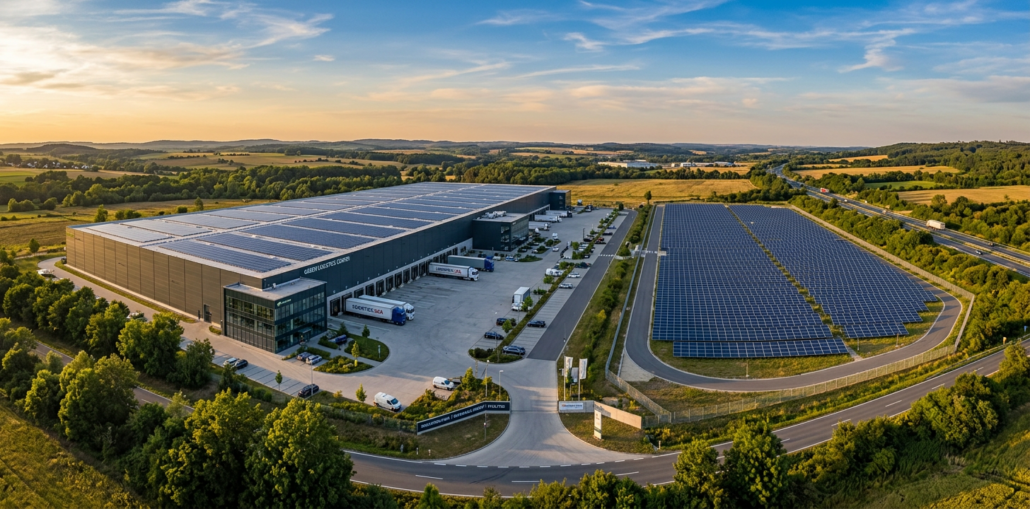
A commercial solar project can look straightforward from a distance, but the mounting decision shapes nearly every part of its long-term value. Available land, roof condition, utility usage, maintenance access, permitting, future expansion, and even a property's visual priorities can change which path makes sense.
For business owners and sales partners, rooftop vs ground mount solar commercial planning should never be a generic price comparison. We recommend treating it as a site and operations decision first, then building the financial model around the system that genuinely fits.
The good news is that both options can be excellent. The right choice is the one that produces reliable energy without creating avoidable roof, land-use, access, or customer-expectation problems later.
Rooftop and Ground-Mount Solar at a Glance
| Decision Factor | Rooftop Solar | Ground-Mount Solar | Best Fit |
|---|---|---|---|
| Uses existing space | Uses the roof | Uses open land | Tight commercial sites |
| Design flexibility | Limited by roof layout | Flexible tilt and orientation | Larger, open properties |
| Site preparation | Often lower | May require grading and fencing | Strong, ready roofs |
| Maintenance access | Height and roof safety matter | Ground-level access | Operations-focused sites |
| Future expansion | Limited by roof area | Often easier to expand | Campuses and industrial land |
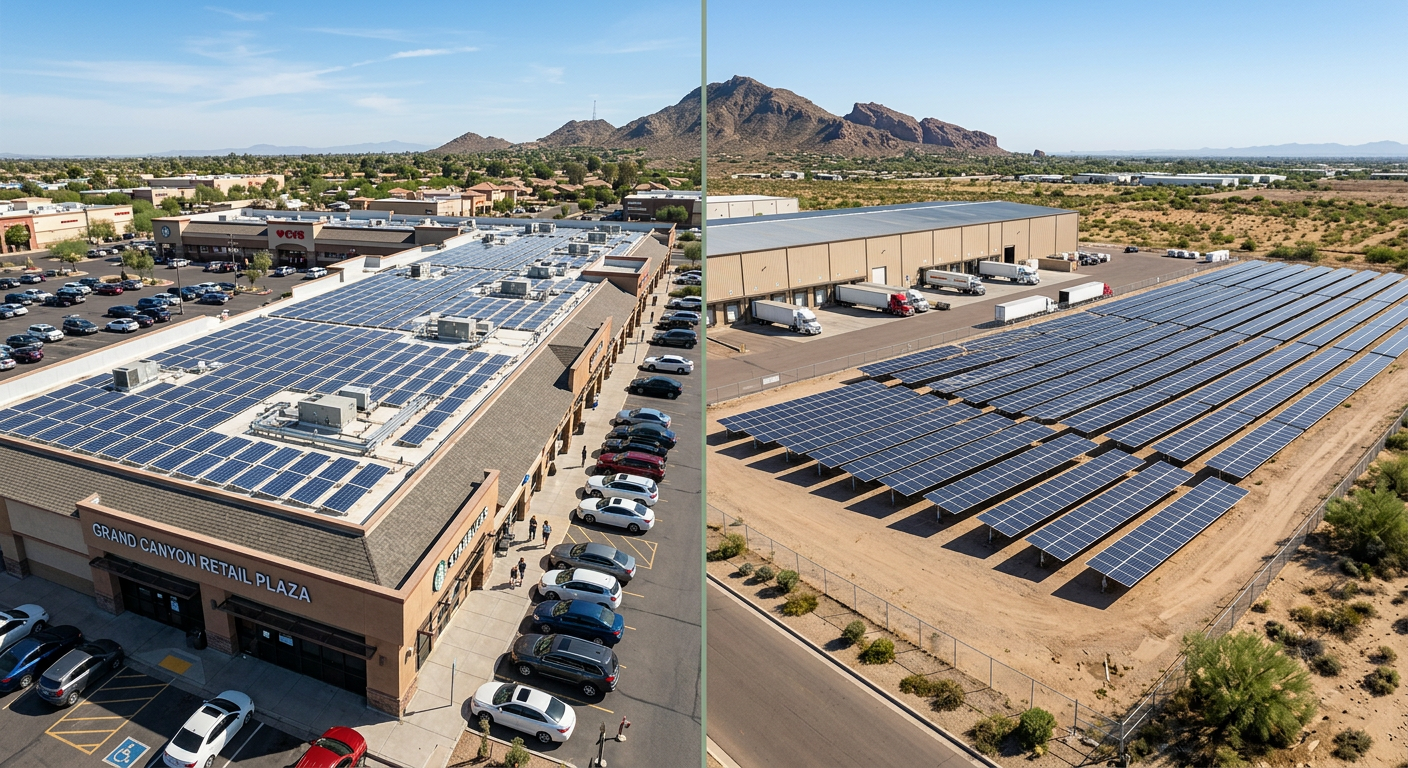
When Rooftop Solar Is the Stronger Commercial Choice
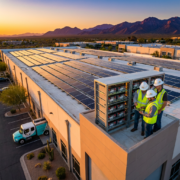
Rooftop arrays turn an underused building surface into an energy asset. For retail centers, offices, schools, churches, multifamily buildings, and warehouses with structurally sound roofs, this can preserve valuable parking, loading zones, landscaping, and developable land.
Rooftop solar keeps the project within the building footprint
A roof-mounted system is often the practical answer when a business has little or no unused land. It can be especially compelling in dense commercial areas where every ground-level square foot supports customers, deliveries, tenant access, or future construction.
A good rooftop design starts with a structural review, roof age assessment, shade analysis, fire-access planning, and a realistic inventory of HVAC equipment, skylights, vents, and setbacks. A large-looking roof is not automatically a large usable solar roof.
It can reduce ground-level disruption
Rooftop systems may avoid some grading, trenching, fencing, and land-use complications associated with a ground array. That does not mean the project is simple, though. Crane access, roof safety, attachment methods, waterproofing coordination, and future reroofing plans all need to be addressed before a proposal becomes a contract.
For dealers, this is where a commercial-grade installation partner matters. Presenting a structural and roofing plan early helps prevent a client from feeling surprised after the sale, which protects your reputation as much as the project's economics.
Rooftop solar works best when the roof has runway
We generally see the strongest rooftop opportunities where the roof has at least a meaningful remaining service life, a workable load capacity, limited obstructions, and favorable sun exposure. If a reroof is imminent, it is usually smarter to coordinate the roof scope and solar timeline rather than install panels only to remove and reinstall them shortly afterward.
The National Renewable Energy Laboratory reports that modeled first-year commercial PV capacity factors range from 12.7% to 19.8% across U.S. solar-resource classes, with a 15.8% national mean. Site-specific irradiance, shading, orientation, equipment choices, and operating practices determine where a particular project falls within that range. National Renewable Energy Laboratory
When Ground-Mount Solar Creates More Value
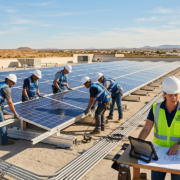
Ground-mounted solar places the array on dedicated racking in open space near the facility. It is often the more flexible option for industrial sites, large campuses, warehouses with constrained roofs, agricultural-adjacent properties, and businesses with room to expand over time.
The array can be designed around production goals
Unlike rooftop arrays, ground mounts are not dictated by roof angles, parapets, vents, or mechanical equipment. The design team can often optimize row spacing, tilt, orientation, and equipment placement for the site, rather than negotiating around a building's existing limitations.
That flexibility can matter when the goal is to offset a large share of daytime load or reserve roof space for future maintenance equipment. It can also make a ground array a better option when a roof's structural limits would require expensive reinforcements.
Maintenance is more accessible
Ground-level access can simplify inspections, module cleaning where appropriate, inverter service, vegetation management, and repairs. The tradeoff is that commercial owners need a clear operations plan for fencing, security, drainage, mowing, dust control, and vehicle access.
A ground system is not maintenance-free. It is simply maintained differently, and those responsibilities should be priced and explained from the beginning.
Land use and permitting deserve early attention
Ground solar can require civil work, geotechnical evaluation, setbacks, screening, fencing, drainage planning, and local land-use approvals. Interconnection equipment and trenching distance to the main electrical service can also change the installed cost.
NREL notes that a one-megawatt ground-mounted solar installation commonly requires roughly five to seven acres, depending on topography and project design. That is a useful planning benchmark, not a substitute for a site layout and local permitting review. National Renewable Energy Laboratory
How We Compare Commercial Solar Site Economics
The lowest initial price does not always create the highest lifetime return. We compare the cost per installed watt, expected annual production, utility-rate structure, demand charges, roof work, civil scope, maintenance needs, financing terms, incentives, and expected property changes over the life of the system.
Start with the utility bill, not panel count
A facility with sharp afternoon peaks may benefit from a different design than one with a broad daytime load. Solar production should be modeled against interval usage when available, because an array that produces more total kilowatt-hours is not automatically the one that creates the best bill savings.
Battery storage can add another layer to the analysis. For businesses facing high demand charges or resilience concerns, a solar-plus-storage strategy can shift the conversation from generation alone to load management and backup capability. Explore our perspective on commercial battery storage solutions for businesses and dealers.
Evaluate incentives with qualified professionals
Commercial property owners should build incentives into the financial model carefully, rather than treating them as guaranteed savings. The IRS states that the Clean Electricity Investment Credit has a base amount of 6%, which may increase to as much as 30% when prevailing wage and registered apprenticeship requirements are met. Additional bonuses may apply in specific circumstances. Internal Revenue Service
We encourage clients to review tax eligibility, entity structure, wage and apprenticeship requirements, and credit-transfer options with qualified tax and legal advisers. Good tax guidance supports a credible proposal. Overpromising incentives can damage the relationship before installation begins.
A Commercial Solar Decision Framework We Use
The practical choice becomes clearer when we work through the same sequence on every serious opportunity.
Review roof condition and structural capacity
For rooftop solar, ask how old the roof is, what warranty remains, whether structural documents are available, and where equipment and safety pathways must remain clear. A roof replacement or reinforcement requirement does not necessarily end the project, but it must be included in the decision.
Map open land and site constraints
For ground mounts, identify usable acreage, easements, drainage paths, existing utilities, traffic patterns, future development plans, and zoning restrictions. A parcel can look open while still being unsuitable for solar because of setbacks, flood concerns, underground infrastructure, or planned expansion.
Model energy production and operational value
A quality proposal should compare production, savings, payback assumptions, and maintenance considerations using the actual site. We do not recommend selling a customer on an idealized output number that ignores shading, degradation, curtailment risk, or access limitations.
Choose the design that remains sensible after year five
This is the question that prevents short-term thinking. Will a rooftop system complicate a planned roof replacement? Will a ground array occupy land needed for a new loading area? Is the owner likely to add electric vehicle charging, tenant improvements, or battery storage later?
Why Dealers Should Offer Both Options
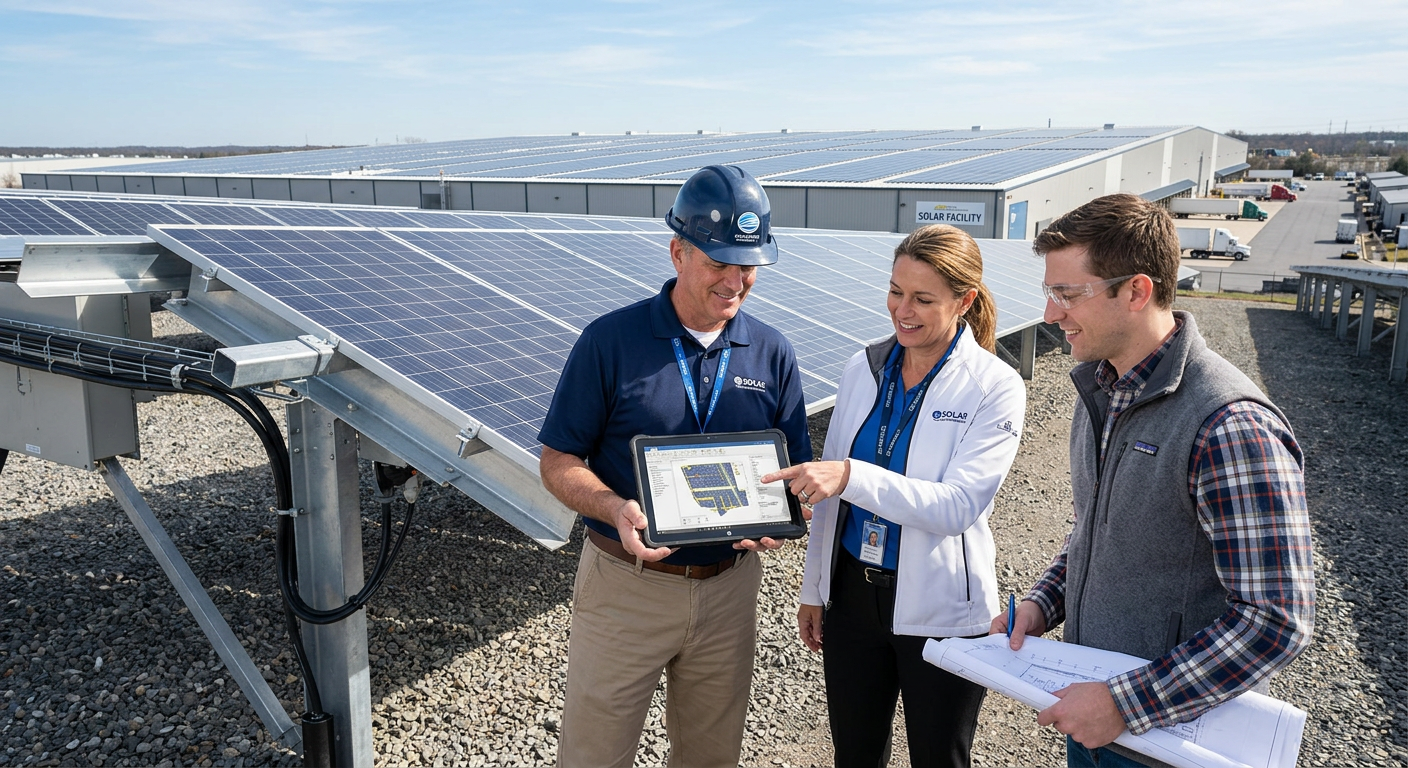
A sales partner who can discuss both mounting approaches has a stronger commercial conversation. Instead of forcing a rooftop proposal onto every property, you can help the buyer understand the operational tradeoffs and present a recommendation that is easier to defend to ownership, finance teams, and facilities staff.
That credibility creates better client outcomes and more durable referral relationships. It also gives dealers a wider addressable market across retail, hospitality, multifamily, light industrial, schools, churches, and commercial campuses.
If you want installation support, design coordination, transparent communication, and a professional brand behind your proposal, apply to become a solar dealer. We help dealer partners bring commercial-grade rooftop, ground-mount, and storage opportunities to market with clearer expectations from the first conversation.
Reputation is part of the product in commercial energy sales. Before you align your name with an installer, review the available Independent Solar customer feedback and look for evidence of responsiveness, workmanship, and follow-through.
For a deeper comparison of site-specific tradeoffs, read our related guide on ground-mount and rooftop solar for commercial properties.
Common Questions About Commercial Solar Mounting
Is rooftop or ground-mount solar cheaper for a commercial project?
It depends on the site. Rooftop systems can avoid land acquisition and some civil work, while ground mounts may avoid costly structural upgrades and allow a more optimized layout. The right comparison includes roof work, site preparation, electrical routing, permitting, production, and long-term operating costs.
Does ground-mount solar produce more energy than rooftop solar?
It can, but not automatically. Ground systems often offer greater flexibility for tilt, orientation, and row spacing, while a well-oriented, unshaded rooftop can also perform very well. Production should be based on a location-specific model rather than a rule of thumb.
Can a commercial property use both rooftop and ground-mounted solar?
Yes. A combined design can make sense when a business wants to maximize usable roof space while also using available land for additional capacity. This approach requires coordinated electrical design, interconnection planning, and a clear understanding of future site changes.
What happens if a roof needs replacement after solar is installed?
The panels and mounting equipment may need to be removed and reinstalled during reroofing. That is why we recommend evaluating roof age and condition before finalizing a rooftop project. Coordinating solar with a planned reroof can reduce disruption and improve long-term value.
Is battery storage a fit for rooftop and ground-mount systems?
Yes. Storage can be paired with either configuration when it supports goals such as demand-charge management, resilience, time-based rate optimization, or backup power for critical loads. The value depends on the utility tariff, load profile, system controls, and the customer's operating priorities.
How can sales reps reduce risk on commercial solar projects?
Work with a partner that validates site conditions before making firm promises, documents assumptions, communicates schedule changes clearly, and provides support after commissioning. To build a commercial pipeline with that kind of support, become a dealer with Independent Solar.
Build a Stronger Commercial Solar Pipeline
A dependable partner helps you sell a solution you can stand behind. If you are a dealer, sales representative, or channel partner looking to add commercial solar and battery storage opportunities, submit a dealer application to explore how we support project design, installation coordination, and long-term client confidence.
We believe transparent communication, reliable execution, and durable service are essential to protecting both the property owner's investment and the dealer's reputation.
The Best Mount Is the One That Fits the Site
Rooftop solar is often the smart move when a property has a capable roof, strong sun exposure, and limited usable land. Ground-mounted solar can be the better investment when open space, design flexibility, simpler access, and future expansion outweigh site-preparation costs.
The decision should be grounded in site facts, not a one-size-fits-all sales script. When we evaluate rooftop vs ground mount solar commercial opportunities honestly, we help businesses make stronger energy decisions and give dealer partners a solution they can represent with confidence.


 Arizona:
