
Commercial Solar Maintenance Contracts That Protect Long-Term ROI
Few things create more risk for a commercial solar investment than treating post-installation support as an afterthought. A system can look great on commissioning day, yet lose value over time when monitoring alerts go unanswered, equipment records disappear, or a small inverter fault becomes weeks of missed production.
That is why commercial solar maintenance contracts deserve the same attention as system design, financing, and installation quality. For property owners, they create a practical plan for protecting uptime and controlling service costs. For dealers and sales reps, they provide the confidence to promise clients something more valuable than panels, long-term accountability.
What A Strong Contract Should Deliver
A maintenance agreement should not be a vague promise to “service the system as needed.” It should define exactly how the provider watches performance, responds to issues, documents work, protects warranties, and communicates with your team.
The U.S. Department of Energy notes that comprehensive photovoltaic operations and maintenance can improve average performance ratio from 92% to more than 95%. That difference can matter when a retail center, warehouse, school, hotel, or multifamily property depends on solar savings in its operating budget. Department of Energy
| Contract Element | What It Covers | Why It Matters | Best Fit |
|---|---|---|---|
| Remote monitoring | Alerts and production tracking | Finds problems early | All commercial sites |
| Preventive service | Inspections and electrical checks | Reduces surprise failures | Rooftops and ground mounts |
| Response commitments | Defined service windows | Sets clear expectations | Busy operating facilities |
| Reporting | Production and repair records | Supports ROI decisions | Owners and asset managers |
| Warranty support | Claim coordination | Limits administrative burden | Dealers and property teams |
Monitoring That Leads To Action
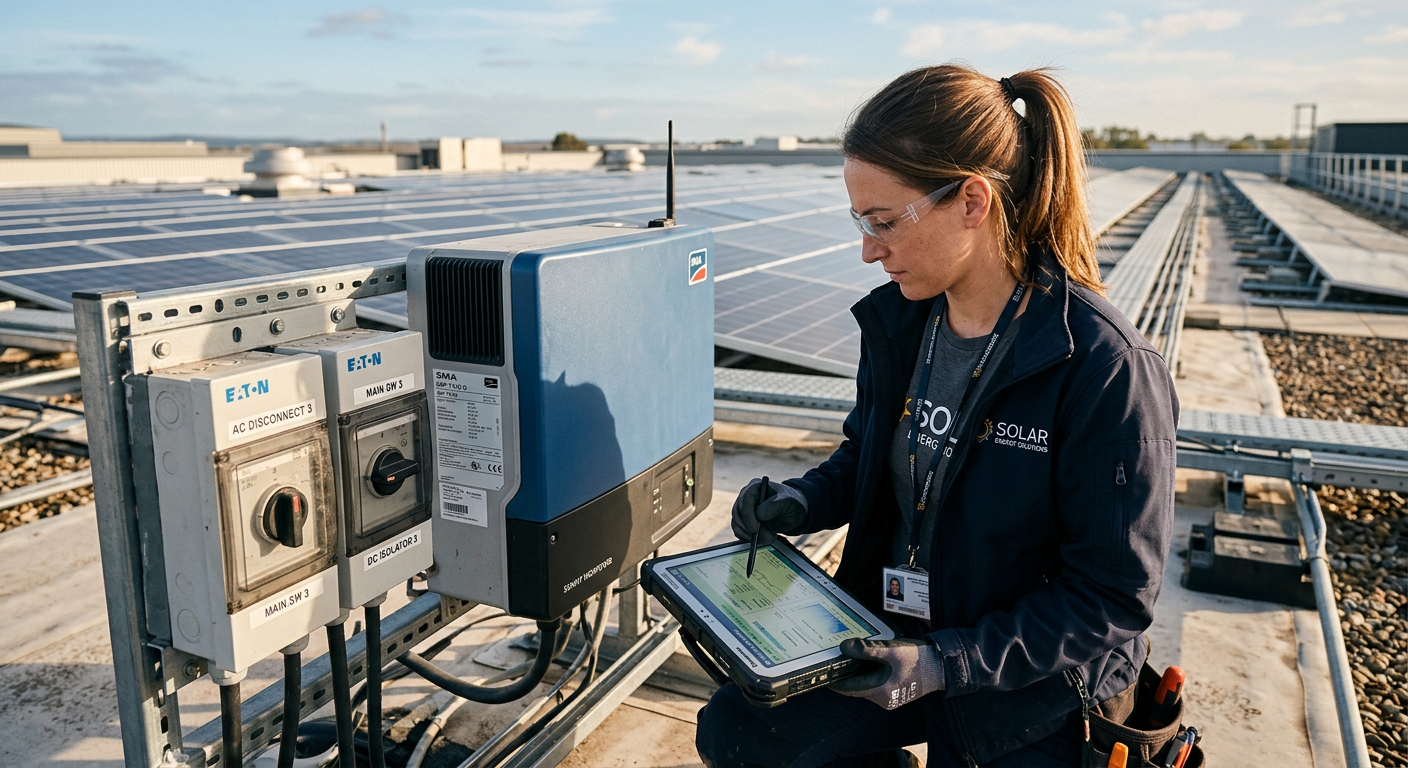
Monitoring only creates value when someone owns the alerts. Your agreement should identify the platform, the reporting schedule, which performance indicators are tracked, and what happens when production falls outside an expected range.
For larger systems, regular reporting is especially important. Department of Energy guidance suggests quarterly performance reporting for systems from 1,001 kW to 3,000 kW and monthly reporting for systems above 3,000 kW. Department of Energy
Preventive Visits, Not Just Emergency Repairs
A service plan should include scheduled visual inspections, electrical checks, inverter reviews, roof and racking observations, wire management, and documentation of any corrective work. In Arizona, Nevada, and Texas, dust, extreme heat, storms, wildlife activity, and changing shade patterns can make a site-specific service calendar far more useful than a generic annual visit.
Cleaning should also be based on real site conditions, not assumptions. A property near construction, agriculture, highways, or desert dust may need a different schedule than an office building in a cleaner urban setting.
How To Compare Commercial Solar Maintenance Contracts
The lowest annual fee is rarely the best value. We recommend comparing scope, exclusions, labor assumptions, response commitments, and reporting quality before comparing price alone.
Ask About Service Levels
Response commitments should be written in plain language. Define what qualifies as an emergency, what qualifies as a priority outage, when remote diagnosis begins, and when an on-site visit is expected.
A warehouse with refrigeration loads, a hospitality property with guest expectations, and a school managing budgeted utility costs do not all need the same response plan. The contract should fit the business consequences of downtime.
Clarify What Is Included And Excluded
Many disagreements happen because a contract says “maintenance” without defining the work. Confirm whether the fee includes travel, troubleshooting, minor corrective labor, cleaning, thermographic testing, vegetation management, firmware updates, and post-storm inspections.
Also ask how the provider handles major component failures, replacement parts, equipment shipping, crane access, roof work, utility coordination, and manufacturer warranty claims. Clear boundaries protect both the property owner and the dealer who brought the project forward.
Require Useful Reporting
A commercial owner should receive more than a service invoice. Ask for production summaries, open issue logs, work orders, photos where relevant, repair recommendations, and a record of warranty activity.
Good reporting turns maintenance into a management tool. It gives facility teams evidence for budget planning, helps ownership understand system performance, and makes future refinancing, portfolio review, or property sale less complicated.
For a deeper checklist, review our guide to commercial solar operations and maintenance agreements and our practical commercial solar maintenance checklist.
Why Service Agreements Protect Solar ROI
Solar modules are designed for long operating lives, but every commercial system includes active components and site conditions that need attention. Inverters, communications hardware, electrical connections, meters, batteries, roof penetrations, and racking all deserve a documented plan.
A National Renewable Energy Laboratory review of nearly 2,000 measured degradation rates found a median photovoltaic degradation rate of 0.5% per year. Normal long-term aging is expected, but avoidable downtime and unnoticed faults can add losses that have nothing to do with standard module aging. National Renewable Energy Laboratory
Battery Storage Needs Its Own Scope
If a project includes energy storage, do not attach a one-line battery add-on to a solar-only agreement. The contract should address thermal management, communications, state-of-charge behavior, firmware updates, safety procedures, emergency contacts, and planned testing for backup or demand-management functions.
That detail matters for businesses using storage to manage demand charges, maintain critical loads, or improve resilience. Read more about planning for solar battery storage as part of a broader commercial energy strategy.
Documentation Protects Warranties And Reputation
A complete service history makes it easier to support warranty requests and demonstrate responsible ownership. It also protects the reputation of the dealer or sales partner who recommended the system.
Here is the thing, commercial clients remember how issues are handled long after they forget the sales presentation. They want a partner that communicates clearly, follows through, and leaves a clean record of what was found and fixed.
A Better Offer For Dealers And Sales Partners
For B2B sales teams, maintenance is not simply a back-end service. It is a differentiator that can help you win deals against providers who compete only on upfront price.
When you offer a professional O&M plan, you can show prospective clients that you have thought beyond installation day. That builds trust with retail groups, office owners, hospitality operators, multifamily decision-makers, churches, schools, HOAs, and light industrial facilities.
Build Recurring Value Instead Of One-Time Transactions
A well-structured maintenance offering can improve retention, create future upgrade opportunities, and reduce the risk of post-sale frustration. It also gives you a better reason to stay connected with the client as energy needs, equipment, incentives, and storage goals change.
Independent Solar supports dealer partners with commercial-grade installation, maintenance, repairs, and transparent post-sale coordination. If you want to represent a company that helps protect your client relationships after the contract is signed, you can become a solar dealer and explore a partnership built around long-term reliability.
Put Social Proof In The Sales Conversation
Commercial buyers do their homework. They want proof that an installer communicates well, stands behind completed work, and treats service as part of the relationship.
Before bringing a solar partner into an important client conversation, review customer feedback and project experiences. Positive reviews do not replace technical due diligence, but consistent feedback can reinforce the service standards you want associated with your own name.

Questions To Settle Before Signing
How often will the system be physically inspected?
The right schedule depends on system size, weather exposure, dust levels, roof access, equipment type, and monitoring quality. Many sites benefit from regular visual checks and one or more detailed technical service visits each year, plus inspections after major storms or abnormal production events.
Who receives alerts after normal business hours?
Name the responsible party and explain the escalation path. If the monitoring platform flags an inverter outage overnight, the agreement should show whether the provider receives the alert, who is contacted, and what response timeframe applies.
Does the contract include warranty claim management?
It should clearly explain who gathers evidence, contacts the manufacturer, coordinates replacement equipment, and manages labor after approval. A strong provider reduces administrative load for the owner and keeps the dealer from becoming the middleman for every technical issue.
Are cleaning and vegetation control included?
Sometimes they are included, and sometimes they are separate services. The important point is to specify how cleaning decisions are made and who handles site conditions that cause shading or soiling-related losses.
What happens after hail, wind, or severe weather?
Your plan should include a post-event assessment process, photo documentation, safety steps, and coordination with insurers when appropriate. Commercial sites in storm-prone areas should not wait until damage occurs to decide who owns the response.
Can the agreement transfer when the property changes hands?
Often it can, but the transfer process should be written into the contract. A transferable maintenance agreement can add practical value during a property sale because the new owner inherits a clear service history and support path.
Partner With A Team That Supports The Full Lifecycle
We believe a commercial solar project should strengthen your reputation, not create avoidable callbacks after installation. Independent Solar helps dealers, sales reps, and commercial property owners align installation quality with maintenance, repairs, storage planning, and responsive support.
If you are ready to bring a more complete solar offering to your clients, apply to become a dealer. We help partners build confidence with commercial-grade work, clear communication, and long-term service expectations.
The Bottom Line
The best commercial solar maintenance contracts make performance visible, service predictable, and accountability easy to understand. They protect the asset, support better operational decisions, and give businesses a clear path when equipment needs attention.
For dealers, the opportunity is just as important. When you work with a reliable solar company that stays engaged after installation, you can sell with more confidence and create relationships that lead to referrals, repeat business, and stronger long-term growth. If that is the kind of partner you want behind your next commercial project, become a solar dealer.






 Arizona:
