
Commercial Solar Financing Options for Businesses That Work
Businesses are under pressure to control overhead, improve resilience, and make smarter long-term capital decisions. That is exactly why commercial solar financing options have become such a practical conversation for owners, operators, and channel partners.
Here’s the thing, the best financing strategy is not just about getting a project approved. It is about matching the deal structure to the property, the tax position, the utility bill, and the organization’s long-term goals. For dealers and sales reps, that also means aligning with a partner that makes you look prepared, credible, and easy to work with.
Introduction
Commercial solar is no longer a niche add-on. It is a business tool that can reduce operating costs, support energy planning, and strengthen the asset value of a property. But the financing structure matters just as much as the equipment.
If you are evaluating a project for a retail center, office, hotel, HOA, church, school, or light industrial facility, you need a financing path that makes sense on day one and keeps making sense years later. That is where dealer support, tax-credit guidance, and trustworthy execution all come into play.
The Main Commercial Solar Financing Options
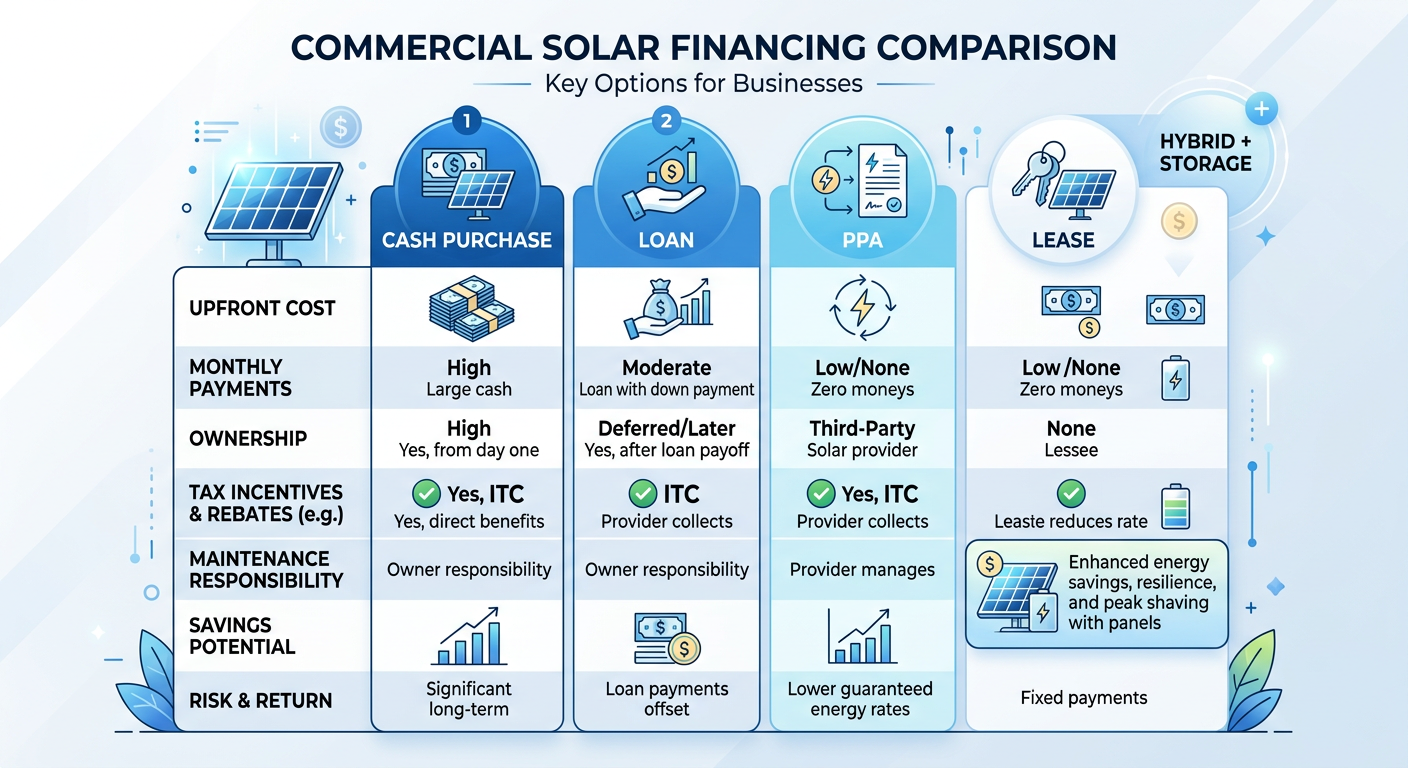
Cash Purchase
A cash purchase gives the business full ownership from the start. That usually means the simplest structure, the strongest long-term savings, and the fastest path to improved return on investment.
This option works especially well for organizations with strong balance sheets and a clear tax strategy. It can also be attractive when the owner wants maximum control over the asset and wants to simplify future maintenance and refinancing decisions.
Solar Loan
A loan spreads project cost over time, which helps preserve working capital. For many businesses, this is the most balanced option because it creates predictable payments while still allowing the company to own the system.
A well-structured loan can pair nicely with utility savings, which helps the project cash flow from the beginning. For dealers, this is often an easier conversation than trying to sell the lowest sticker price, because the focus shifts to monthly economics and long-term value.
Power Purchase Agreement
A Power Purchase Agreement, or PPA, lets the business buy the solar energy produced by the system rather than buying the system itself. This can reduce upfront cost and appeal to organizations that want immediate savings without taking on ownership responsibilities.
PPAs are not perfect for every site, but they can be a strong fit when the property owner wants a low-entry option and the project economics still support meaningful utility bill reduction.
Solar Lease
A lease gives the customer the right to use the system for a fixed payment. Like a PPA, it lowers the barrier to entry, which can be helpful for organizations that prefer operating expense treatment over capital expense.
This can work for certain commercial buyers, but it is important to compare the long-term math carefully. Some businesses will benefit more from ownership, while others will value the simplicity and lower initial commitment of a lease.
Hybrid Structures with Storage
For sites with demand charges, outage risk, or load volatility, battery storage can change the economics. Combining solar with storage may improve resilience and help reduce peak demand costs.
For a deeper look at how storage can support commercial sites, see commercial battery storage solutions and how it can fit into a broader project plan.
What Business Owners Should Compare Before Choosing
Upfront Cost Versus Lifetime Value
The cheapest option on paper is not always the strongest business decision. Look at total savings over time, not just the first invoice.
Tax Treatment
Different structures affect how incentives and deductions are captured. Businesses should review the tax implications early, especially if the project may benefit from the federal solar tax credit.
Maintenance and Performance Risk
Ownership can bring greater savings, but it also means you need a reliable installer and a clear service plan. That is why reputation matters so much in commercial work.
Flexibility for Future Growth
If the building footprint, tenant mix, or electrical load may change, choose a financing structure that leaves room for expansion, battery integration, or system upgrades later.
Why Dealers and Sales Reps Should Care About Financing
For B2B partners, financing is not a side topic. It is often the difference between a stalled proposal and a signed agreement. When you can explain financing clearly, you shorten the sales cycle and build confidence faster.
That is also why it helps to work with a partner that supports your brand. Independent Solar is built for commercial-grade installations, transparent support, and a professional dealer experience, which makes it easier to protect your reputation while you grow.
If you are evaluating a stronger partner network, Become a Dealer and see how a structured commercial program can support your next sale.
How Independent Solar Helps Businesses Make the Right Choice
Independent Solar supports commercial buyers and dealer partners with financing guidance, tax-credit education, battery storage options, system upgrades, maintenance, and repairs. That matters because the project does not end at installation.
The company also emphasizes long-term reliability and communication, which is exactly what business owners want when they are making a capital decision. If you want proof of how that shows up in real projects, review the customer reviews and see how trust plays into the buying process.
For commercial property owners in Arizona, Nevada, and Texas, the right financing structure can make solar far more accessible. For dealers, the right installer partnership can make your pipeline more credible and your close rate stronger.
Common Questions About Commercial Solar Financing
What financing option is best for a business with limited cash flow?
A loan, lease, or PPA may be a better fit than a cash purchase because they reduce upfront cost. The best option depends on how the business wants to balance monthly payments, ownership, and tax benefits.
Do businesses still benefit from ownership if they finance the project?
Yes. Financing a system still allows many businesses to own the asset and capture long-term value, while spreading payments over time.
Is battery storage worth financing with solar?
It can be, especially for businesses with demand charges or reliability concerns. Storage can improve resilience and may add value when the load profile supports it.
Why does installer reputation matter so much?
Because commercial projects affect operations, budgets, and brand trust. A weak installer can create delays, poor communication, and long-term service issues.
How can dealers benefit from commercial solar financing knowledge?
It helps you present better proposals, answer objections, and build trust faster. It also makes it easier to align with a reliable commercial partner like Independent Solar.
Where should I start if I want to become a partner?
Start with the Become a Dealer application and review the company’s reviews before you build your next commercial pitch.
Take the Next Step with a Stronger Solar Partner
If you are a business owner, the right financing option should lower risk, support cash flow, and improve the long-term value of the property. If you are a dealer or sales rep, the right installer partner should make you look sharp, not leave you chasing answers.
That is why so many partners focus on reputation, support, and commercial execution first. Become a Dealer with Independent Solar, and give your clients a partner they can trust from proposal to installation.
Conclusion
Commercial solar financing is not one-size-fits-all. Cash, loans, PPAs, leases, and hybrid storage structures each serve a different kind of business need.
The best outcomes happen when the financing, the tax strategy, and the installer all work together. If you want a more confident commercial solar conversation, start with a partner that values communication, quality, and long-term reliability.



 Arizona: